Installation: Motus

Created 2014:

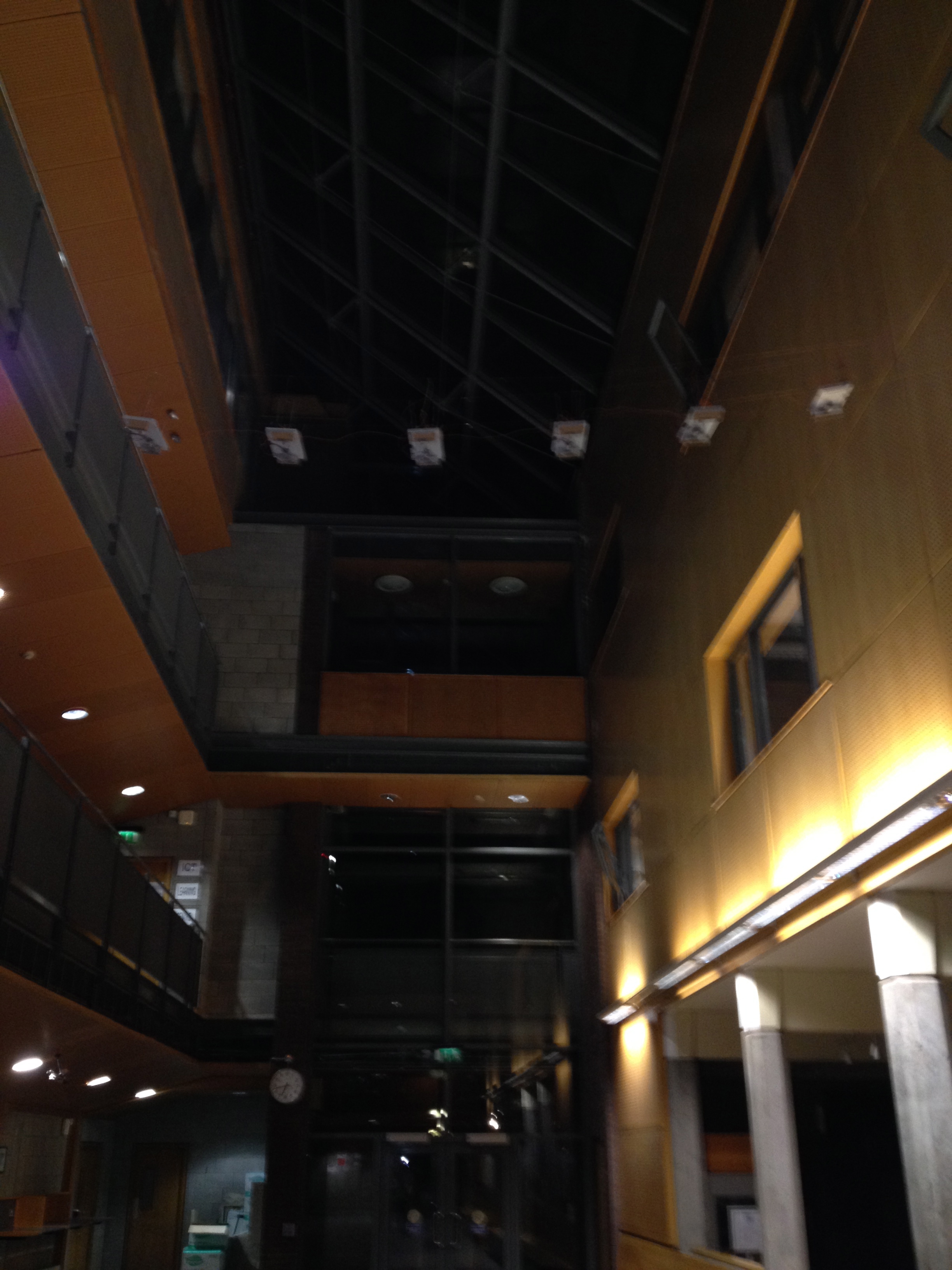
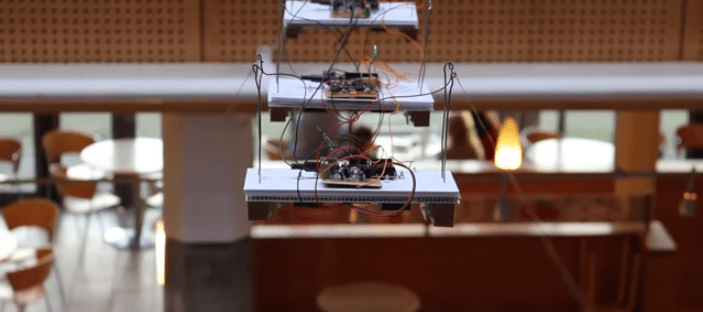
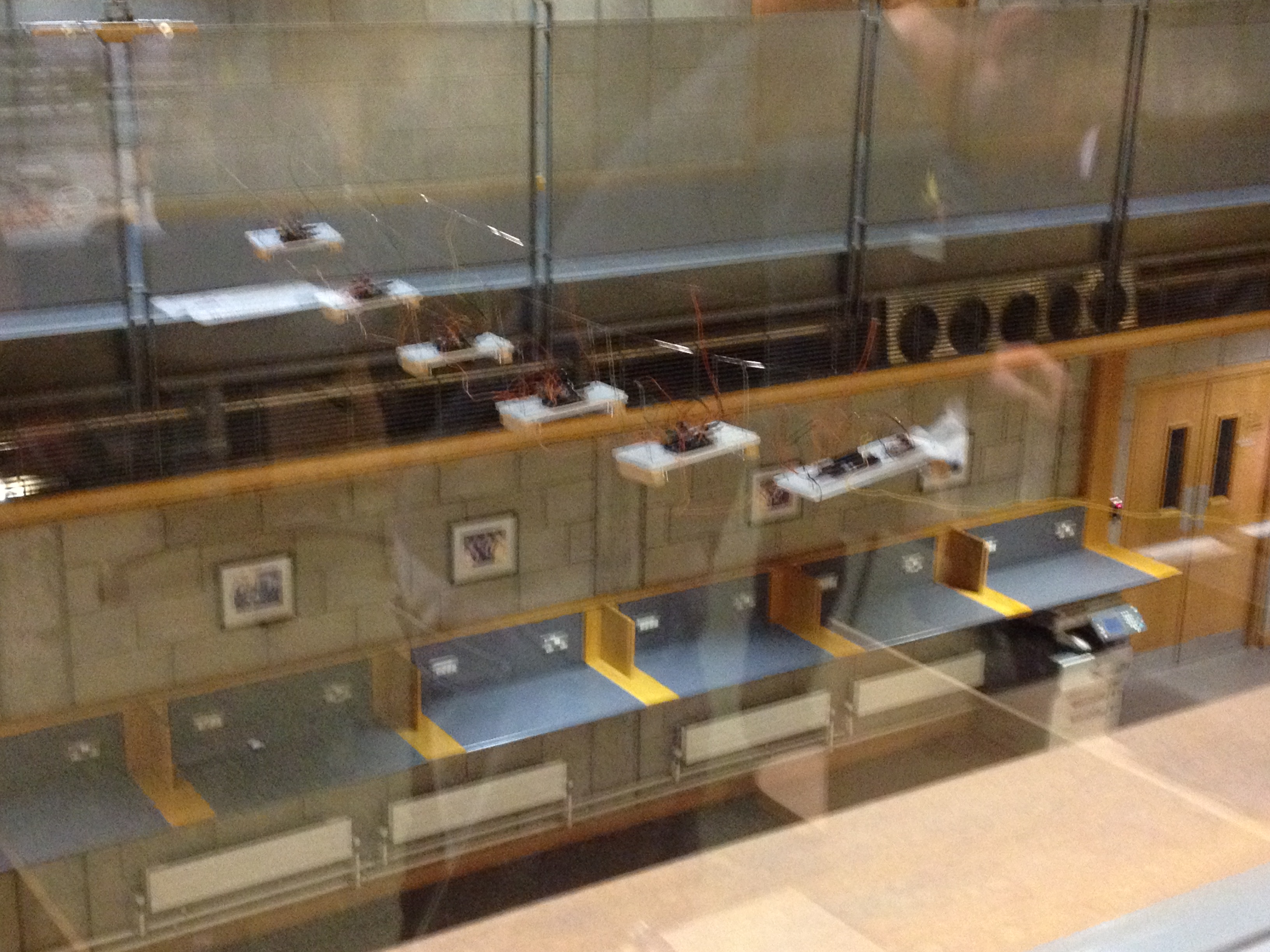
Motus is one of the two installations that makes up the exhibition ‘If this then that or that?’ Created by the fourth year students of Music Media and Performance Technology at the University of Limerick, Motus observes the development of simple agents that registers its real time environment activity and provides a representation of that data with specific sonic outcomes. The hallway of the Computer Science Building (CSIS) in UL, exhibits varying types of activity levels every day. It can often turn from hectic happenings one moment to a serene environment in another. But what of this energy that populates the CSIS? One of the aims of the Motus installation is to take this ambience that people create in the hallway and recreate it sonically. The installation attempts to accurately replicate atmosphere of its previous 3 hours 9 minutes. An IR sensor logs the activity level of the people passing. Therefore, humans, perhaps unknowingly, are the driving force behind the piece. Once this data is recorded, it is reinterpreted using a Arduino Uno microcontrollers which generate an output through solenoids. Through the power of sound, the piece attempts make reconnections back to human activities.
Installed
Installed

Testing Circuit

Testing Circuit

Floor  View

Floor View

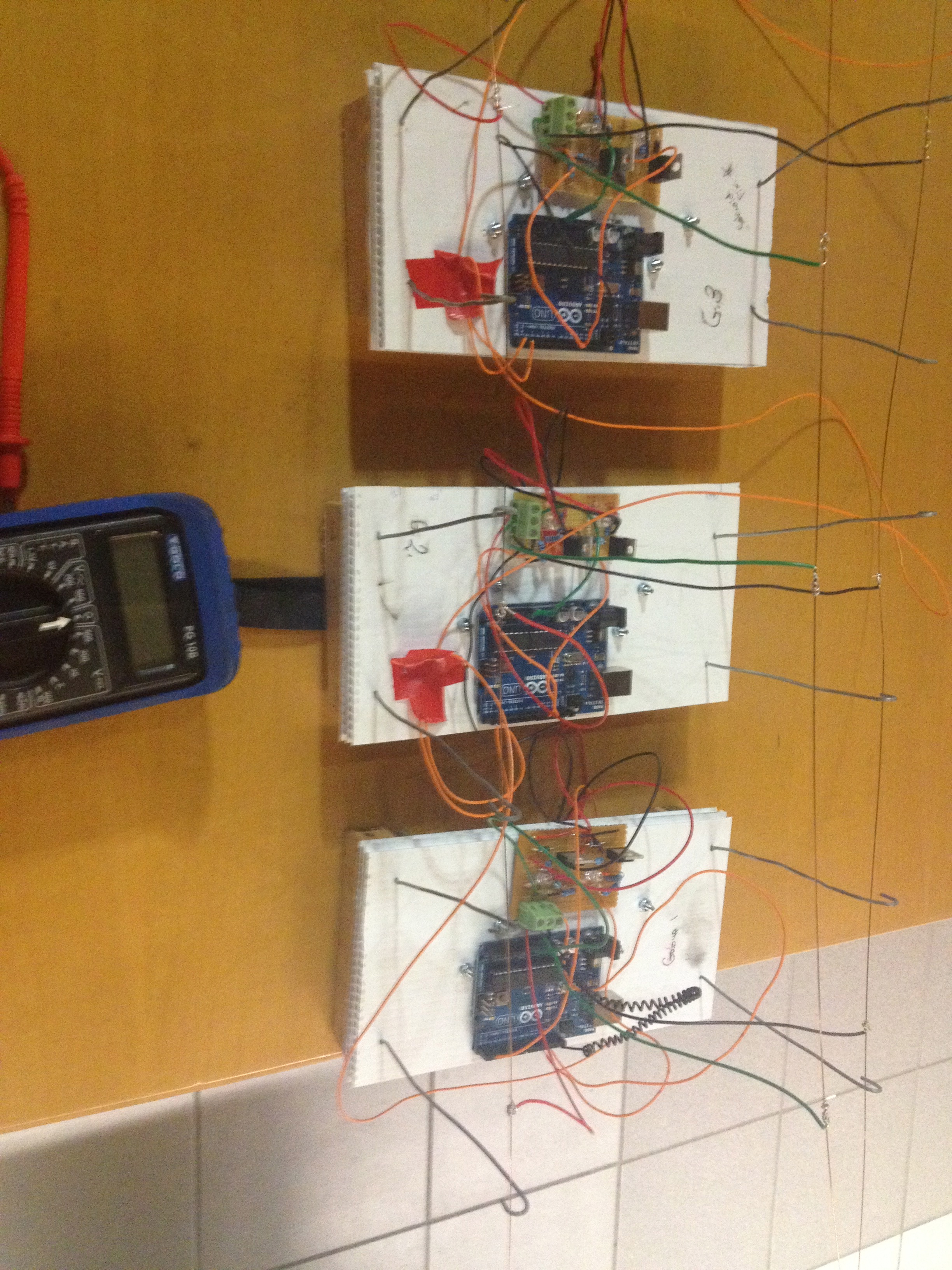
The simple circuit was created in order to safely provide power to each solenoid . This circuit was to be replicated a further 5 times for each agent. The circuit is made up of two solenoids (one for the master), two LEDs, two 10k Ohms resistors, a 220 Ohms resistor, a 150 Ohms resistor, 47k Ohms resistor, a Darlington Driver and an N- Channel MOSFET.

The aim was to create an agent that could be both aesthetically pleasing and also sported a simplistic appearance. Considerations when making the design include build effectiveness, portability and cost efficiency. Sketches were drawn up before collecting materials to build. Corrugated plastic was used as the flat based to hold the circuit board/Arduino one-side and Solenoids, blocks and Glockenspiel keys on the other.

Explanation Video:

(credit to fellow student Stuart Duffy who created the above video)

My Role:

Roles were primarily split into four: Designers, Circuitry, Input Code and Rule implementation. I was heavily involved in the programming. This involved me writing code  for our specific Arduino Slave (the 50  unique rules reactive to activity conditions) and also contributing to the Master Arduino that will dictate how it stores crowd activity, how long and when it will play etc. This was done using Serial Communication. I also did a large amount of debugging. This involved creating dummy prototypes to test my groups Arduino Rules and also test all the slaves at once sending them false data from Pure Data. 

I have a paper written which thoroughly describes the programming, the design, circuitry and concept  of our project, Feel free to contact me.

AudioVisual Project: Binary Opposition

Created 2014:

The aim of this group project was to create a short (roughly 1-2 min) audio-visual composition, showing:
•    Original Content
•    Aesthetic Concept
•    Coherent Structure

Concept:

  • The perceptual unification (or making equivalent) of two dissociated representations of the same reality through a minimalistic audio‐visual composition. (Subverting the advertising efforts of a corporation.)
  • A video piece that displays the contrasting narratives put forth by corporations/vested interests and activists.
  • This piece displays two depictions of (parallel) realities. One of which consumers
    are more exposed to on a daily basis. It serves as a contrast between those two perceptions of reality; “inviting” aesthetics vs. “unpleasant” ones.
  • Channel A: a lavish high-end production; brand/product image; and corporate power. Displaying the power of seductive aesthetics. The corporate, glamourised advertising methods which mask the barbaric methods used to make certain products.
  • Channel B: amateur production hidden costs and victims. Revealing a ‘realistic perception’, which corporations would rather hide from public view.

Technical Approach:

  • Raw files were used which were taken from online sources. One Herbal Essence advertisement and footage of animal testing. These video sources were then tactically edited together within Max MSP for absolute accuracy.
  • Majority of the experimentation incorporated Max MSP.

My Role in this project:

  • Researched the subject matter.
  • Experimented with several Max MSP techniques/effects to explore different compositional strategies discussed.
  • Found relevant art pieces that were significant to our concept or shared similar subject matter.

Final Product:

Politics and Ethics:

Due to the inaccuracy of events suggested in the video, this is not intended for public attention, until the source material has been updated accordingly. It is only on this portfolio to showcase a previous project.

The online research did not find evidence to support a connection between the product featured in the advertisement (namely Clairol’s Herbal Essences) and cosmetics testing on Macaque monkeys or other non-human primates.

The proposed content of the piece would have clearly suggested to viewers that a direct link existed between the product being shown and the laboratory scenes in which a monkey was being experimented-on. Since hard evidence was not available to support the existence of such a link, the truthfulness of the piece was called into question.

To take liberties with the truth in a piece which itself purported to reveal a more essential form of it was deemed to be socially irresponsible by the artists. Furthermore, as a form of social and political activism, it was reckoned that it could have been ultimately self-defeating to drum-up support for a cause using potentially fictitious evidence. This would have, ironically, also aligned the artists more closely with the propaganda they sought to discredit.

A temptation, however, remained to use the available footage despite those potential consequences. This was due to the following reasons: Procter & Gamble (the parent company of Clairol, owner of the Herbal Essences brand) are still engaged in animal testing of their cosmetic products in China (News, 2013). In 2008, it was revealed that Herbal Essences product ingredients were inhumanely tested on rats (News, 2013). In 2011, P&G falsely claimed that Herbal Essences was not tested on animals and were forced to retract the claim by the Advertising Standards Authority in the UK (Uncaged, 2011). Finally, in 1990 P&G reportedly lobbied against legislation to prevent a ban on the Draize test in California (Wesleyan, 2014). So while P&G/Herbal Essences cannot be directly linked to animal testing activity involving primates, it can be inferred that their activity supports the institutions and culture in which such testing is condoned and practiced.

Nevertheless, it was deemed that using the macaque testing footage was ineffective and the piece would not be released publically until an accurate substitute was found, e.g. footage of Draize tests or cosmetic tests on rats.

Max MSP Algorithmic Processes

Created 2014:

For own final assessment in Digital Media Software and Systems 4 in 2013, we were required to build a music performance system in Max MSP that illustrates the algorithmic processes covered in this course. We had to perform with this system in a live context, in groups of five people. Each one of use would focus on different algorithmic processes within our patch. The video below is just a demonstration of my part. Others focused on drums samples, vocoders, synth etc. and we would then play together simultaneously. The algorithmic processes which we studied for this involved:

• random, drunk, and urn
• weighted distribution
• Markov chain
• fractal or self-similar process
• Logistics Map
• other chaotic process (Hénon, etc.)

The patch demonstrated below features Markov Chain and random, drunk, and urn. Our aim as a group was to manipulate the stochastic behaviour of the algorithms in such a way that is was still pleasing i.e. or notes were random but only within specific scales in order to sound pleasing.

Demonstration:

(I will be rerecording a demo of this with internal recording to omit the noise interference,)

Short Film: Frank

Created 2013:

The was a group project that entailed the production of a HDV short film with Foley Sound replacement, ADR dialogue replacement and sound design. The aim was to achieve expertise in the use of cameras, lighting, audio-recording, editing and sound-design.

My Role:

I undertook the responsibility of managing the sound. Dissimilar to our previous projects, I was required to explore the techniques used specifically for sound recording in greater detail. As a team, we decided that all of our audio attributes of the short film would comprise of Foley and ADR methods. Both of these techniques are implemented during the postproduction of a film. As our team captured footage, my sound recording colleague and myself recorded the raw sounds. By recording these raw sounds during filming and then add our own in postproduction, we had complete control over the timing, quality, and relative volume of the sound effects. Same rule applied to how we captured dialogue. Our entire dialogue was re-recorded within the studio. Once we finished capturing the film, we were then able to make a full list of dialogue and Foley requirements. Trying to create the correct recipe for an accurate replication took a few trials. Not all-sound replacement was recorded in the studio. We recorded live atmospheres, birds, cars, door sounds etc. using a Rode microphone. We did this because these sounds were elements that were hard to imitate within the Foley studio. A constant reference to levels was also pivotal. The setup within the studio provided us the opportunity to capture a professional standard of sound recording, making the most of auxiliaries’ sends, buses, headphones, monitors, dual room communication etc. All of our sounds were recorded dry and later effects such as reverb, panning, filtering were added. We put strong use to our knowledge about proximity effect, region recording, and loop playbacks. We recorded several versions of each Foley effect and Dialogue replacement and then selected the best fitting. Once all are sounds were recorded and edited, they were then prepared to be located correctly within the film. The end goal is to make these Foley and ADR’s sounds seem as natural as possible.

Screenshots:

On Set

On Set

On Set 2

On Set 2

On Set 3

On Set 3

Final Product:

Viral Video

Created 2013:

This project was undertaken by myself and my group. Our objective was to create a short clip with the hope that it could go viral. It was an opportunity for us to show case our enhanced skills in editing and also incorporate a green screen into one of our projects for the first time, introducing chroma keying technique.

As described by in the video description, the software that was used was:

Adobe After Effects CS6 (rotoscoping, compositing, chroma-keying)
Adobe Premier Pro CS6 (editing, audio timing)
Adobe Audition CS6 (recording, processing, mixing)
IK Multimedia T-RackS Custom Shop (reverb, EQs, dynamics processing)
Adobe Illustrator CS6 (creating vector lettering for mask)
Adobe Photoshop CS6 (creating ‘Jumbo Hot Dogs’ mask

Short Film: 101 CSIS

Created 2012:

The purpose of this project was to demonstrate our skills regarding video production. The process involved strengthening my knowledge in the correct use of lighting and sound, as well as operating the camera, when recording. This was a team based project and I felt we functioned very well together. Delegating roles and using time efficiently is always key within working as a unit. My primary roles within this project was directing and editing the footage using Final Cut Pro. Our objectives were as follows :

  • Invent a story
  • Draw storyboards / Write a dialogue script / Extract a shot-list
  • Timetable our action
  • Shoot the footage, enhancing your scene with lighting for indoor shots
  • Record at least some of your audio with external microphones
  • Log & Capture in PAL anamorphic not HDV
  • Import additional songs / Voice-Overs / ADR / Sound-design / Commentary

In comparison to previous video projects, I felt we handled our time management a lot better which gave me time to closely edit the short film (it even gave us time to re shoot and add scenes). This was a project I thoroughly enjoyed, specifically the editing duties. The short film itself self is a form of documentary comedy which was influenced by a John Mayor skit. Thought we aimed to be entertaining and provide good acting, our ability to use the equipment and software tools were our primary goals.

Final Product:

Short Animation : Terms of Rhythm

Created 2012:

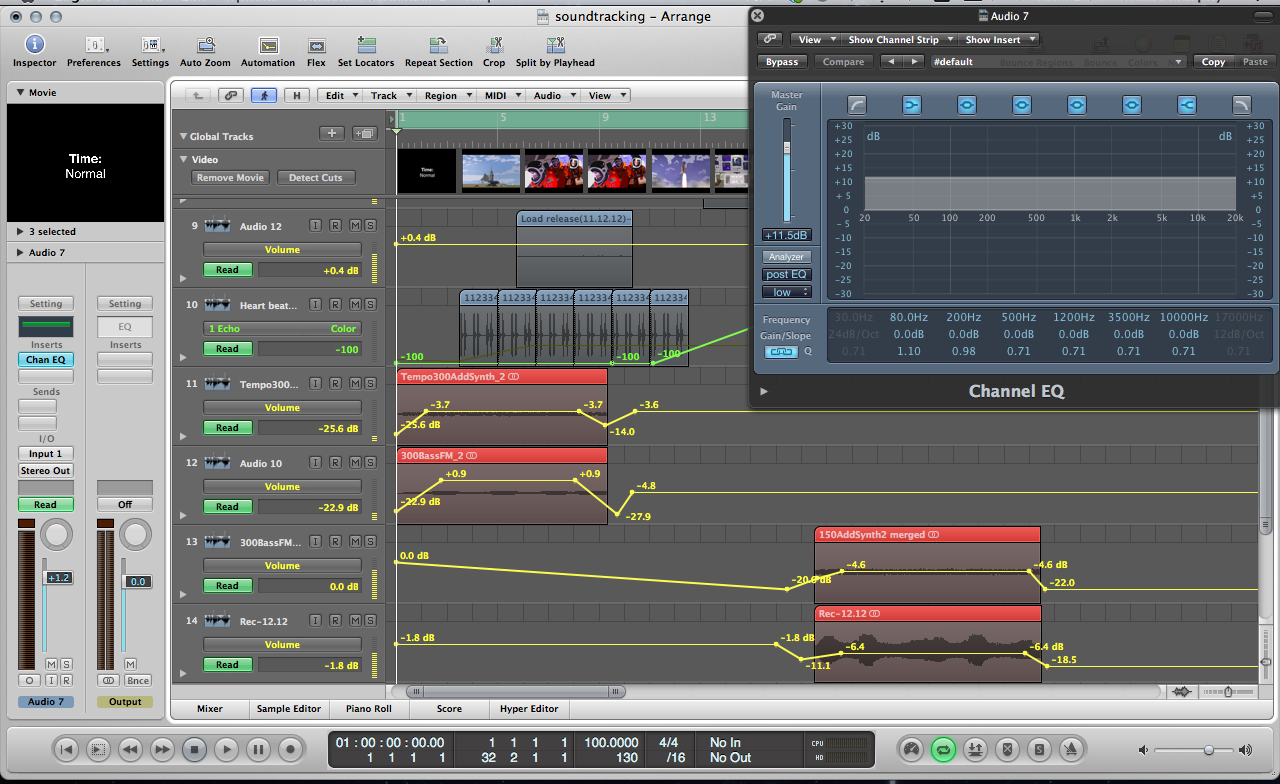
Short clip which combined the use of Max MSP instruments we created to correspond the actions of animation created using Adobe Illustrator.  This was a group project whereby my main responsibility was to create the composition that plays throughout the animation. The composition was created within Max MSP. Further edits were later made to the piece within Logic Pro, just to add an effect or two such as fade ins, volume control, reverb etc. We all shared the workload evenly with others focusing on the animation and sound effects.

Concept:

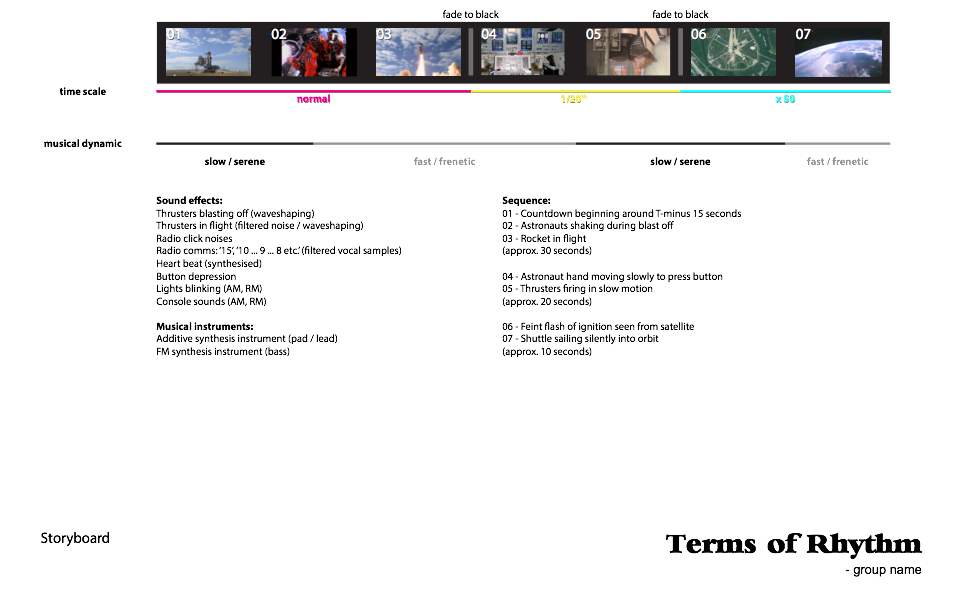
Terms of Rhythm’ explores the emotional aspects of the human psychological and psychophysical responses to events at different time scales. The word rhythm is taken in both its traditional musical sense of ‘regular recurrence, esp. of stresses’ (Chambers 20th Century Dictionary) and also in the broader sense of patterns occurring on scales which lie outside the span of perceptible rhythm where—ordinarily—’the perception of the rhythm, objective or subjective, disappears if the intervals are either too short or too long’ (Fraisse, 1982). It is a study of the human experience of time exemplified in the special case of an astronaut manning a launching space shuttle. The event of the launch is played at 3 different time scales: normal, 1/20th speed, and x50 speed respectively. It is observed that the experience of tension is diminished on those scales far removed from normal human perception raising the question of whether or not the metaphysical essence of the event (as a whole) is maintained invariantly across different time scales. A musical composition characterised by having both slow, serene sections alternated with contrasting fast, frenetic sections is layered over the 3 time sections such that each rate of time is experienced with both slow and fast dynamics. This challenges the viewer’s assumptions of what the astronaut is experiencing emotionally.

Screenshots:

Storyboard

Storyboard

Edits in Logic

Edits in Logic

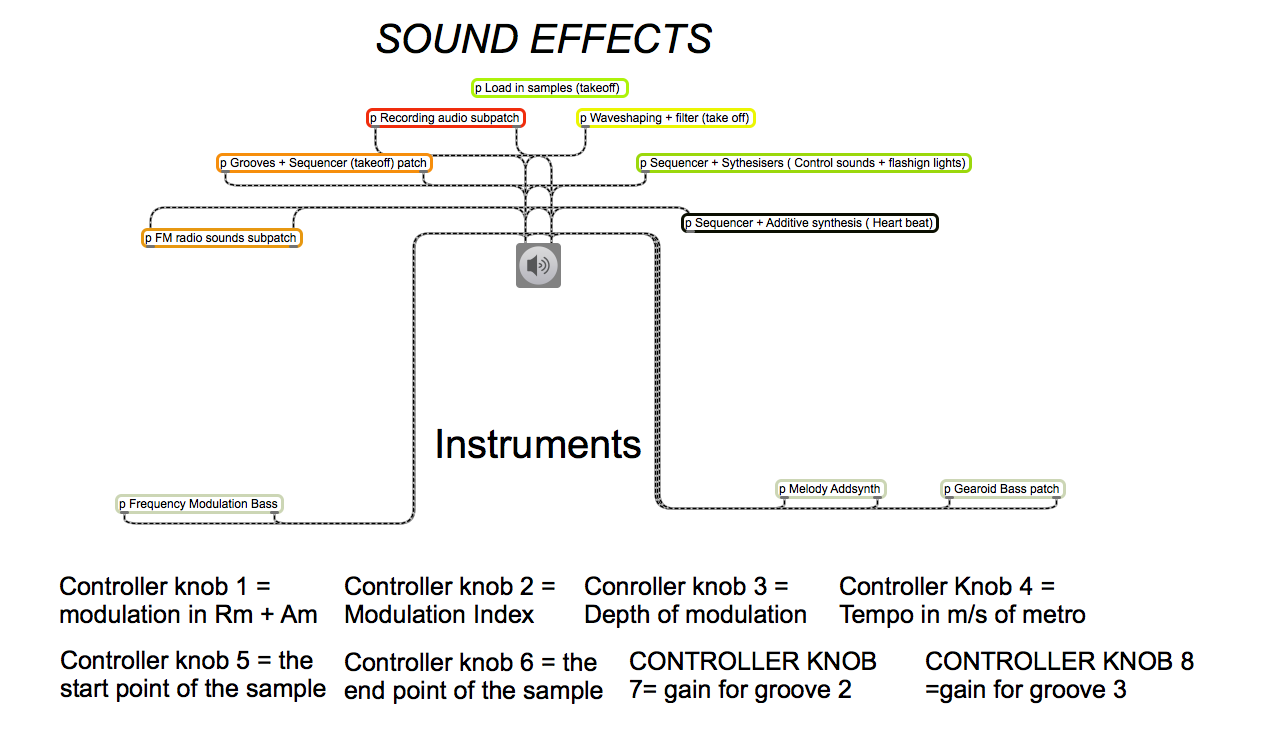
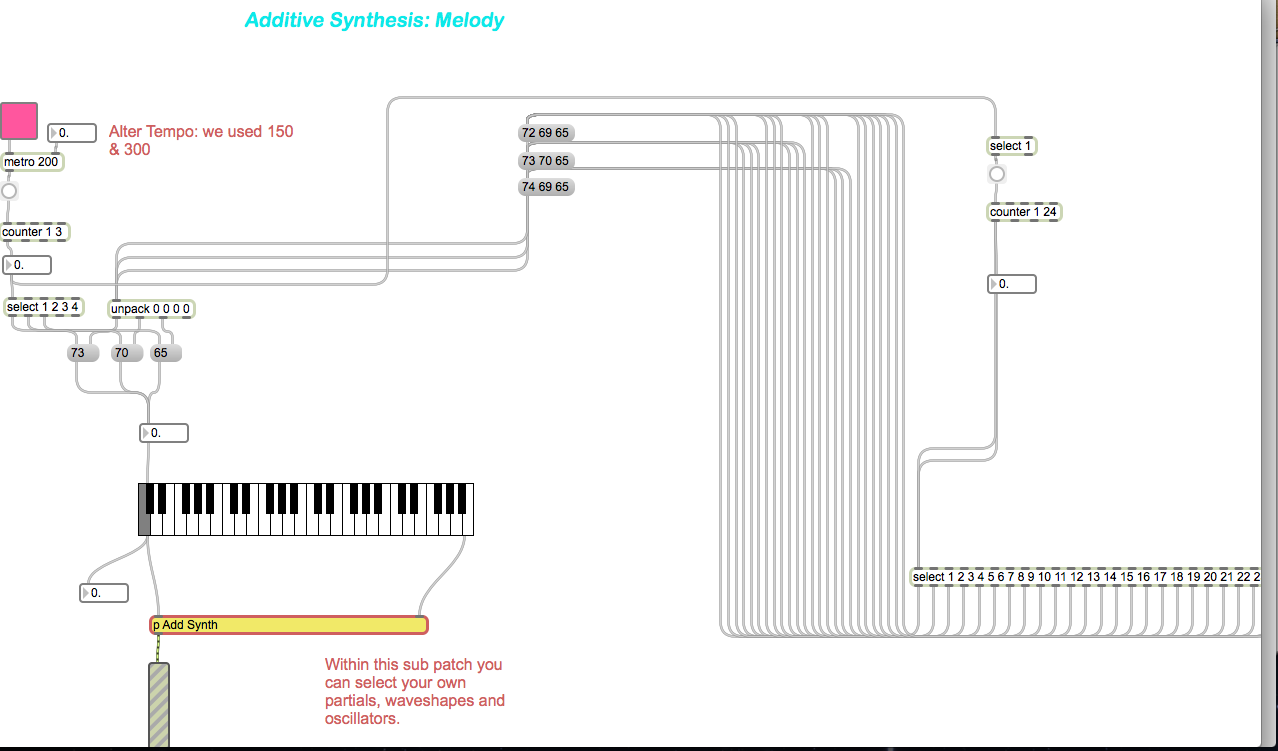
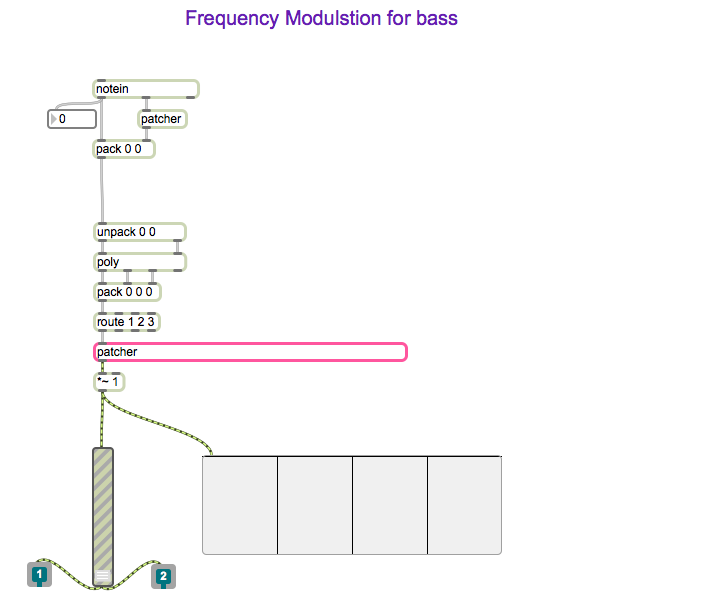
Max MSP Instrument sub patches

Max MSP Instrument sub patches

Max MSP patch segment

Max MSP patch segment

Max MSP patch segment

Max MSP patch segment

First Short Film: The Big Rob Down

Created 2012:

This was a group project that was given to us in 2012. It was my first real opportunity to be involved in a short film. This projected served as a chance to focus on my technical ability with regards to filmmaking i.e. using equipment and software tools. I was thankful that I was delegated the responsibility of editing the film. The software that I used was Final Cut Pro. I carefully edited the film together paying close attention to audio levels, transitions between scenes, effects, seamless continuity and much more. The film was titled ‘The Big Rob Down’ and is featured below.

30 Minute Radio Show: ‘The Mixxed Bag’

Created 2010:

In 2010 myself and two other colleagues created our very own 30 minute radio show. We performed all tasks our ourselves. Duties involved:

  • Good knowledge of broadcasting and recording equipment.
  • Be familiarized with the broadcasting studio and desk.
  • Preform vox pops and interviews to incorporate into our shows.
  • Having regular meetings to ensure that we can agree on material that we think would be most entertaining for our target audience.
  • Up to date knowledge on news and the music scene.
  • Editing skills using audio software such as Cubase, Audacity or Adobe Audition.

My primary task was the editing. I worked mainly with Adobe Audition and Cubase to piece our show together.I had to decide the best parts from our recordings, edit together with smooth transitions and keep the show under 30 minutes. Additionally, I also performed vox pops, interviews, gave creative inputs and even had a small festival review on the show.

This was the final product of our show: